A verse that describes our YWAM adoptive moms… we honor you!
Sunday, May 11, 2014
Saturday, May 10, 2014
Birthmother’s Day
Today, the Saturday before Mother's Day, is Birthmother's Day. It's a day to recognize and honor those women who made a very difficult and loving choice to place their child for adoption.
In Ethiopia, this decision was most often made because of extreme poverty or illness, leaving the birthmother without any ability to provide food, basic needs or a future for their child or children. Sometimes the birthmother is deceased and this difficult decision falls to the father or another living relative.
We have heard birthmothers tell us - with tears - that God has answered their prayers in placing their child in a family, giving them the hope and a future that she was unable to provide. Most of us cannot imagine having to make a choice like this.
Birthmothers hold a very special place in the community of mothers. I know that this weekend as they receive flowers and gifts of love from their children, many adoptive moms will be thinking of the women who gave them the priceless honor of raising their child.
_________________________________________________
While our ministry director, Joy Casey, is in Ethiopia this month she is meeting with many birthmothers to deliver photographs and update letters from the families who adopted their children.
Be sure to read these posts about birthmothers in Ethiopia:
Desperate Mothers
May We Never Forget
The Decision to Relinquish
Friday, May 9, 2014
A Small Business Success Story!
by Joy Casey in Ethiopia
The last two days I have visited all three Adoption Ministry 1:27 project areas in Addis Ababa. The days have been full from morning to night and I have heard incredible stories of both heartbreak and victory. I have put in miles and miles of walking along back roads, down narrow alleys, and striding across open fields to visit the families cared for by this life-altering ministry. Some visits were to get updates on living conditions and to assess needs, but the majority of my time has been spent talking to women about starting a small business and how that would look for them.
Nine months ago, Anchinaleu received money from her sponsor to start an injera baking business, and she is doing so well!
Injera is Ethiopian cultural bread that is made from teff, Ethiopia’s wheat, and is mixed with hot water and then left in big vats to ferment.
Once it is fermented, it is baked on a large round griddle fueled with wood or electricity and is a staple of every Ethiopian’s diet. Injera is full of iron and is also gluten free.
Anchinaleu is an energetic and optimistic woman who has tackled her business opportunity with vigor and bakes 100 pieces of injera a day selling them to three small restaurants. She makes $15 a day. So far, she has managed to save more than half of the money she needs to repay the small loan given for her business start-up. That is incredible!
She is optimistic for her future and would like to move to a larger house that could incorporate a separate place for her injera fermenting vats and stove.
I have been very encouraged with the eagerness of the women I have interviewed. They intend to work hard and want to be successful at providing an honest living for their families. We have now received the correct license from the Ethiopian government to move into this realm of small financing. Our business managers are putting together business plans for the women and we will then seek financing for them. Stay tuned!
Thursday, May 8, 2014
Offering a Living Hope
by Joy Casey in Ethiopia
*photos courtesy of Living Hope Ethiopia
I sighed as I took my first sip of hot, spicy Ethiopia tea. It had been a long two days travel and hefting 100+ pounds of luggage at several junctures left me drained.
Living Hope, A Beacon
The first few days of my time in Ethiopia were spent with my good friend Dinah Monahan, her daughter-in-law Dawn, and a delightful woman named Deana. Upon landing in Addis Ababa we headed directly to Living Hope Women’s Association in Adama, about 2 hours south of the capitol. Living Hope was the brain child of Dinah and me four+ years ago, and Dinah has done an excellent job building a wonderful program caring for at-risk unmarried pregnant women and providing schooling and job training so they can be good mothers when they are out on their own.
We were cordially welcomed by the staff, the 14 residents and 11 children.
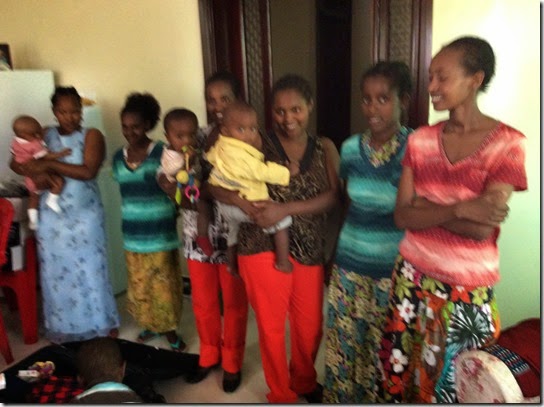
Other women who had received care at Living Hope and now live independently in the community were on hand with their toddlers to greet us, too. It was good to see everyone, kiss sweet baby cheeks and over dinner plan the next several days.
Children, Dogs and Minarets
Exhaustion came early, unfortunately sleep was elusive. Our room opened up onto the courtyard and the mothers and children sat in the evening air laughing and playing with their voices dying down about 9 p.m. The happy noise was replaced with barking dogs. About 3 a.m. crowing roosters joined in and the cacophony was complete about 4 a.m. with the wailing of the minarets. But the biggest barrier to sleep was the buzzing of seemingly millions of hungry mosquitos swarming around my head and no mosquito net!
Sunday dawned brightly ushering in a hot day. The women, Living Hope staff, all the children and the four of us went to church and enjoyed the lively worship, and we Americans tried our best to stay awake during the sermon. Keep in mind... travel weary, no sleep, a very hot day, and preaching in Amharic.
Dinah brought six suitcases full of things for the maternity home. Each resident got to pick out new clothes for herself and her child and the suitcases were emptied of all the teaching materials on fetal development, pregnancy and childbirth, abstinence and abortion to be used in many teaching venues.
Another mostly sleepless night morphed into Monday morning which was a holiday in Ethiopia celebrating Ethiopia’s victory in ousting the Italians in 1896. Meseret, Living Hope’s director, had arranged for Dinah to give a presentation to a group of administrators and teachers from Adama schools. There were about 30 educators riveted to the ultrasound 4D images of a child’s development in the womb. Discussion was held on whether the images they saw were a human baby or something else. Was the baby an individual or just an extension of his mother? We passed around models of babies at the various stages of development for them to hold and look at.
Getting Real About Abortion
Abortion is now legal in Ethiopia and just about every clinic and hospital will accommodate a woman’s wish to terminate her pregnancy. Using fetal models, Dinah explained the various ways an abortion is done depending on the stage of gestation. She then showed an actual abortion that was filmed on ultra sound. I have seen this before and find it very hard to watch, so instead I turned my attention to the people in room. Their faces reflected the horror they were watching. They were stunned and very, very sober. I was once again reminded that abortion is a very brutal affair. Rarely are we faced with the viciousness of this act that is so sanitized and accepted that few of us even cringe today when we hear about millions of human babies killed every year. We are in the midst of a holocaust and yet most of our Christian churches can’t even take the time once a year (one Sunday in January is reserved for Sanctity of Human Life) to educate their congregations about the evils of abortion and the value of life, offer healing to the women who have suffered from an abortion, or to mourn the tiny individuals who will never experience life.
Two Good Questions
Out of a discussion time, two very good questions were proffered.
1) How can we advise a girl to continue her pregnancy when she has no support and most likely will be ostracized from her family?
2) How can pregnancy among unmarried women be prevented?
Dinah did an excellent job casting vision for alternatives to abortion using Living Hope as a model. She challenged them to continue building not only a pro-life platform in Ethiopia but a climate of value and self-worth among their students, especially girls. The attendees were invited to an open house at Living Hope where they could glean ideas and receive literature on ways to care for these vulnerable women in their society.
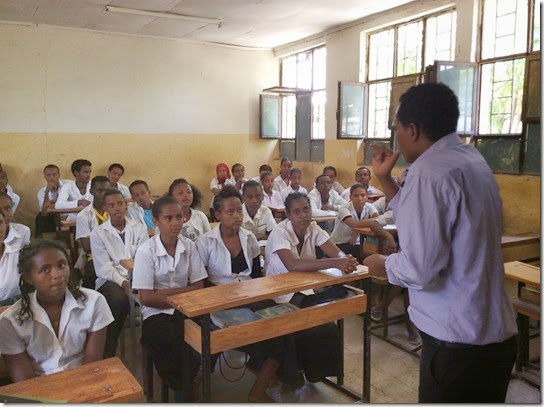
The nurse from Living Hope talked passionately about abstinence that ties into a woman’s dignity and value and also 100% guarantees protection from STDs and HIV. Emshaw has many opportunities to speak in schools about abstinence, and teachers report they are seeing fewer girls drop out of school because of pregnancy and many girls are declaring their determination to wait until marriage before having sex. Emshaw has a gift for engaging both male and female students, and his presentations invite eager questions and a willingness to listen and learn. Perhaps because of the success he has in many schools and the way he presents the subject matter, the audience of adults we had before us respectfully appreciated what he had to say.
Why Can’t We Talk About Adoption?
During these talks, I wanted to jump up and say “Adoption is also a consideration for women who cannot raise a child!” when an individual asked, “What if a girl gets pregnant from incest… should that baby be aborted? What if a girl is raped?”
Why should that child be denied life for the sins of the father? But how can a family be expected to treasure a child that reminds them of their gross sin? Or should a girl be expected to care for a baby that stands as a reminder to a violent, indecent act? These are hard questions with no easy answers, but adoption should be one alternative to be considered. Unfortunately, this venue was not the place to talk about adoption; but sadly, adoption is rarely broached on any broad scale.
That's why our work through the Mana Gammachuu orphanage to help foster an adoption mindset, to educate Ethiopian Christians about adoption and to place abandoned babies into strong families is so exciting!
*photos courtesy of Living Hope Ethiopia
I sighed as I took my first sip of hot, spicy Ethiopia tea. It had been a long two days travel and hefting 100+ pounds of luggage at several junctures left me drained.
Living Hope, A Beacon
The first few days of my time in Ethiopia were spent with my good friend Dinah Monahan, her daughter-in-law Dawn, and a delightful woman named Deana. Upon landing in Addis Ababa we headed directly to Living Hope Women’s Association in Adama, about 2 hours south of the capitol. Living Hope was the brain child of Dinah and me four+ years ago, and Dinah has done an excellent job building a wonderful program caring for at-risk unmarried pregnant women and providing schooling and job training so they can be good mothers when they are out on their own.
We were cordially welcomed by the staff, the 14 residents and 11 children.
Other women who had received care at Living Hope and now live independently in the community were on hand with their toddlers to greet us, too. It was good to see everyone, kiss sweet baby cheeks and over dinner plan the next several days.
Children, Dogs and Minarets
Exhaustion came early, unfortunately sleep was elusive. Our room opened up onto the courtyard and the mothers and children sat in the evening air laughing and playing with their voices dying down about 9 p.m. The happy noise was replaced with barking dogs. About 3 a.m. crowing roosters joined in and the cacophony was complete about 4 a.m. with the wailing of the minarets. But the biggest barrier to sleep was the buzzing of seemingly millions of hungry mosquitos swarming around my head and no mosquito net!
Sunday dawned brightly ushering in a hot day. The women, Living Hope staff, all the children and the four of us went to church and enjoyed the lively worship, and we Americans tried our best to stay awake during the sermon. Keep in mind... travel weary, no sleep, a very hot day, and preaching in Amharic.
Dinah brought six suitcases full of things for the maternity home. Each resident got to pick out new clothes for herself and her child and the suitcases were emptied of all the teaching materials on fetal development, pregnancy and childbirth, abstinence and abortion to be used in many teaching venues.
Another mostly sleepless night morphed into Monday morning which was a holiday in Ethiopia celebrating Ethiopia’s victory in ousting the Italians in 1896. Meseret, Living Hope’s director, had arranged for Dinah to give a presentation to a group of administrators and teachers from Adama schools. There were about 30 educators riveted to the ultrasound 4D images of a child’s development in the womb. Discussion was held on whether the images they saw were a human baby or something else. Was the baby an individual or just an extension of his mother? We passed around models of babies at the various stages of development for them to hold and look at.
Getting Real About Abortion
Abortion is now legal in Ethiopia and just about every clinic and hospital will accommodate a woman’s wish to terminate her pregnancy. Using fetal models, Dinah explained the various ways an abortion is done depending on the stage of gestation. She then showed an actual abortion that was filmed on ultra sound. I have seen this before and find it very hard to watch, so instead I turned my attention to the people in room. Their faces reflected the horror they were watching. They were stunned and very, very sober. I was once again reminded that abortion is a very brutal affair. Rarely are we faced with the viciousness of this act that is so sanitized and accepted that few of us even cringe today when we hear about millions of human babies killed every year. We are in the midst of a holocaust and yet most of our Christian churches can’t even take the time once a year (one Sunday in January is reserved for Sanctity of Human Life) to educate their congregations about the evils of abortion and the value of life, offer healing to the women who have suffered from an abortion, or to mourn the tiny individuals who will never experience life.
Two Good Questions
Out of a discussion time, two very good questions were proffered.
1) How can we advise a girl to continue her pregnancy when she has no support and most likely will be ostracized from her family?
2) How can pregnancy among unmarried women be prevented?
Dinah did an excellent job casting vision for alternatives to abortion using Living Hope as a model. She challenged them to continue building not only a pro-life platform in Ethiopia but a climate of value and self-worth among their students, especially girls. The attendees were invited to an open house at Living Hope where they could glean ideas and receive literature on ways to care for these vulnerable women in their society.
The nurse from Living Hope talked passionately about abstinence that ties into a woman’s dignity and value and also 100% guarantees protection from STDs and HIV. Emshaw has many opportunities to speak in schools about abstinence, and teachers report they are seeing fewer girls drop out of school because of pregnancy and many girls are declaring their determination to wait until marriage before having sex. Emshaw has a gift for engaging both male and female students, and his presentations invite eager questions and a willingness to listen and learn. Perhaps because of the success he has in many schools and the way he presents the subject matter, the audience of adults we had before us respectfully appreciated what he had to say.
Why Can’t We Talk About Adoption?
During these talks, I wanted to jump up and say “Adoption is also a consideration for women who cannot raise a child!” when an individual asked, “What if a girl gets pregnant from incest… should that baby be aborted? What if a girl is raped?”
Why should that child be denied life for the sins of the father? But how can a family be expected to treasure a child that reminds them of their gross sin? Or should a girl be expected to care for a baby that stands as a reminder to a violent, indecent act? These are hard questions with no easy answers, but adoption should be one alternative to be considered. Unfortunately, this venue was not the place to talk about adoption; but sadly, adoption is rarely broached on any broad scale.
That's why our work through the Mana Gammachuu orphanage to help foster an adoption mindset, to educate Ethiopian Christians about adoption and to place abandoned babies into strong families is so exciting!
Wednesday, May 7, 2014
A North Carolina meet-up
by Becky Burns
Jeff and I had the opportunity to visit the beautiful state of North Carolina in April and got to meet with four of our adoptive families living in the Raleigh area.

Battle and Shannon Watkins hosted our afternoon get-together where the kids jumped on the trampoline, played croquet and enjoyed lots of great desserts.
I talk to many families all across the country on the phone but it’s a very special treat if I get to meet them in person. Our adoptive families are some of the very finest people you will ever meet. They love Christ. They have made and will continue to make many personal sacrifices that are a necessary part of parenting children from hard places..
And of course to see the children who I have prayed for over many months and years was the biggest blessing of all. Jeff has taken pictures of most all of them from the time they came into our care at the orphanage and to be able to see them again surrounded by their parents and siblings is pretty amazing!
Thanks to all of you who could make the time to be there with us and especially to the Watkins for having all of us at your beautiful home!
Jeff and I had the opportunity to visit the beautiful state of North Carolina in April and got to meet with four of our adoptive families living in the Raleigh area.
Battle and Shannon Watkins hosted our afternoon get-together where the kids jumped on the trampoline, played croquet and enjoyed lots of great desserts.
| Sena & Raji Baus and Corrie Watkins |
| Daniel Soutter |
| Charlotte Hemphill |
| Milo Hemphill |
I talk to many families all across the country on the phone but it’s a very special treat if I get to meet them in person. Our adoptive families are some of the very finest people you will ever meet. They love Christ. They have made and will continue to make many personal sacrifices that are a necessary part of parenting children from hard places..
And of course to see the children who I have prayed for over many months and years was the biggest blessing of all. Jeff has taken pictures of most all of them from the time they came into our care at the orphanage and to be able to see them again surrounded by their parents and siblings is pretty amazing!
Thanks to all of you who could make the time to be there with us and especially to the Watkins for having all of us at your beautiful home!
The steadfast love of the Lord never ceases;
His mercies never come to an end!
Lam 3:22
Monday, May 5, 2014
Mother’s Day Idea!
Perhaps you are trying to think of something creative to do for your mom this Mother’s Day…
Consider giving a gift from our YWAM Gift Catalog in your mother or grandmother’s name. We will send her a card telling about the gift you’ve given, changing the lives of women, children and at-risk families in Ethiopia.
W Go to our Gift Catalog webpage
W Select a gift and place your secure order online
W Send us an email support@ywamethiopia.com telling us what you purchased and to whom we can send a card.
Thank you for giving a gift that will be SO gratefully received!
Thursday, May 1, 2014
Struggling to Find the Words
by Joy Casey
I am in a bit of a pickle. I work in the midst of appalling situations in Ethiopia and hear stories and see situations that are beyond comprehension… except that I do see them with my very own eyes. And there are times, like today, when I sit in front of my computer screen wondering how I can convey the circumstances of a family in Ethiopia adequately. I have the burden of being that family’s advocate, and without intervention… well, I don’t know how there can be a happy ending.

Hulagershe and Andarge are a married couple with a 14-year-old boy named Ephriam and a 7-year-old girl named Bethlehem. Hulagershe is very ill with uterine cancer and Andarge’s health is precarious because he is HIV+ and does not have good or consistent nutrition… which means his medication does not work well. When he is able, he begs, but there is not enough money for Hulagershe to receive the medical treatment he needs. The family lives with other families in extremely poor government housing where the sanitation is deplorable and there are no amenities. I am not talking about satellite reception or mosquito netting, I am referring to no toilets, no running water, and not enough beds.
Might you be feeling a tap on the shoulder to help? The urgent need is for food, then medical help, then better living conditions for this family of four. For $40.00 a month, you can adopt this family and stabilize their lives.
Please visit our website AdoptionMinistry127 to read more about our program to preserve families and prevent orphans. You can find this family’s profile on the Adopt A Family page here. Thank you!
I am in a bit of a pickle. I work in the midst of appalling situations in Ethiopia and hear stories and see situations that are beyond comprehension… except that I do see them with my very own eyes. And there are times, like today, when I sit in front of my computer screen wondering how I can convey the circumstances of a family in Ethiopia adequately. I have the burden of being that family’s advocate, and without intervention… well, I don’t know how there can be a happy ending.
Hulagershe and Andarge are a married couple with a 14-year-old boy named Ephriam and a 7-year-old girl named Bethlehem. Hulagershe is very ill with uterine cancer and Andarge’s health is precarious because he is HIV+ and does not have good or consistent nutrition… which means his medication does not work well. When he is able, he begs, but there is not enough money for Hulagershe to receive the medical treatment he needs. The family lives with other families in extremely poor government housing where the sanitation is deplorable and there are no amenities. I am not talking about satellite reception or mosquito netting, I am referring to no toilets, no running water, and not enough beds.
Might you be feeling a tap on the shoulder to help? The urgent need is for food, then medical help, then better living conditions for this family of four. For $40.00 a month, you can adopt this family and stabilize their lives.
Please visit our website AdoptionMinistry127 to read more about our program to preserve families and prevent orphans. You can find this family’s profile on the Adopt A Family page here. Thank you!
Subscribe to:
Posts (Atom)
